
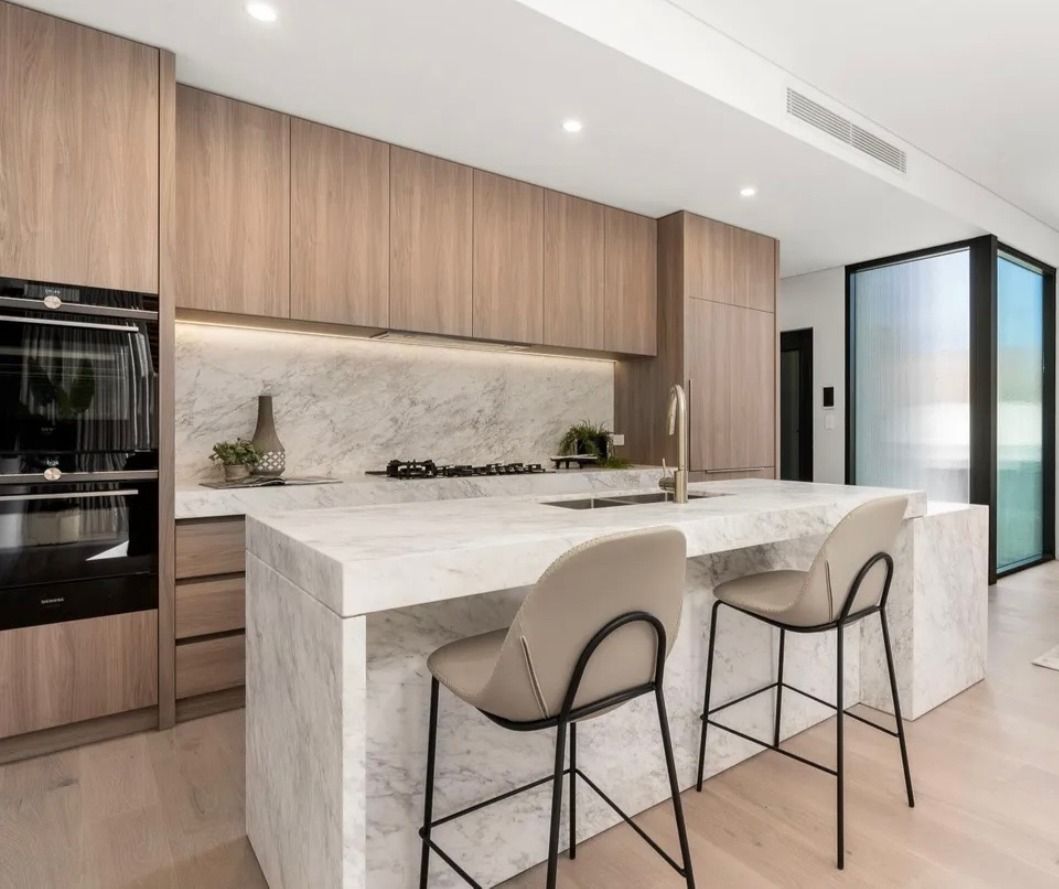
The benchtop is the surface people touch, lean on and judge a kitchen by every day, so it is worth getting the material right. There is no single best choice. Each option balances looks, durability, maintenance and cost differently, and the right one depends on how the kitchen is used and how it needs to sit alongside the joinery. Here is how the main benchtop materials compare, and where we would reach for each.
Porcelain, also called sintered stone
Porcelain benchtops are made from natural clays and minerals fired at very high temperature into a dense, hard slab. Since the engineered stone changes in Australia they have become one of the most specified surfaces, and for good reason. They handle heat, scratches and UV well, they will not stain or etch, and they come in convincing marble looks as well as concrete and solid colours. They can also be made in thin profiles, which suits a lean, modern edge.
Worth knowing. Porcelain is hard but can chip on an exposed edge if it takes a sharp knock, so the edge detail and a careful install matter. It is a specialist material to fabricate, which is reflected in the price.
Engineered stone, now zero-silica
Traditional engineered stone was banned across Australia from mid-2024 because of the silicosis risk to the people who cut it. What is available now is a new generation of zero and low-silica engineered stone, made to sit under the one per cent crystalline silica threshold, so it is compliant and safer to work. It keeps the things people liked about the category: consistent colour and pattern from slab to slab, a wide palette, and a hard, low-maintenance surface.
Worth knowing. If you are drawn to engineered stone, make sure what is quoted is a compliant zero or low-silica product. We only supply and install stone that meets the current rules, which protects our team and keeps your project on the right side of the law.
Natural stone: granite, marble and quartzite
Natural stone is the real thing, cut from a quarried slab, so every top is one of a kind. Granite and quartzite are hard and hard-wearing and take daily use in their stride. Marble is softer and will etch and patina over time, which some people love as character and others would rather avoid. Natural stone was never part of the engineered stone ban, so it remains a completely valid choice.
Worth knowing. Most natural stone needs sealing and a little care with acidic spills, marble especially. Because each slab is unique, it is worth selecting the actual slab so you know exactly what you are getting.
Solid surface, such as Corian
Solid surface is a man-made material, an acrylic and mineral blend that can be worked almost like timber. Its trick is seamless joins: runs, splashbacks and even the sink can be fused into one continuous piece with no visible join and no grout lines to catch grime. It is warm to the touch, comes in many colours, and small scratches or scuffs can usually be sanded out and repaired.
Worth knowing. It is softer than stone and porcelain and less heat tolerant, so it wants a trivet under hot pans. Where a clean, jointless look or an integrated sink is the priority, it is hard to beat.
Timber
A timber benchtop brings warmth and a natural grain that no man-made surface quite matches, and it pairs beautifully with stone elsewhere in the kitchen. It works especially well on an island, a breakfast bar or a secondary run where it becomes a feature rather than the main workhorse.
Worth knowing. Timber is a living surface. It needs oiling from time to time, it will mark and develop a patina, and it does not love standing water or hot pans directly on it. Treated as a feature and looked after, it ages gracefully.
Stainless steel
Stainless steel is the professional kitchen surface, and it has crossed into homes for the same reasons chefs rely on it. It is heat-proof, hygienic, seamless when integrated with the sink, and effectively impervious to stains. It suits an industrial or restaurant-style look and commercial fit-outs where hygiene and durability come first.
Worth knowing. It scratches and develops a fine patina of use, which reads as character in a working kitchen but is worth expecting up front. Fingerprints show on a polished finish, so a brushed finish is often the easier choice at home.
So which one?
If you want low maintenance and a marble look without the upkeep, porcelain or a compliant zero-silica engineered stone are the easy answers. If you want a one-of-a-kind natural surface, granite or quartzite give you that with real durability, and marble if you welcome patina. For a seamless, jointless result or an integrated sink, solid surface earns its place. And timber or stainless are the ones to bring in as a feature, timber for warmth, stainless for a working, professional edge.
In practice most kitchens we build mix two surfaces: a hard-wearing stone or porcelain across the main run, with timber or a contrasting stone on the island to lift it. Because we manufacture and coordinate the joinery and the surfaces together, we can match the benchtop to the cabinetry, the budget and the way you will actually use the space, and make sure whatever is specified meets the current safety rules.
Planning a kitchen or a project and weighing up surfaces? Get in touch and we will talk it through with you.